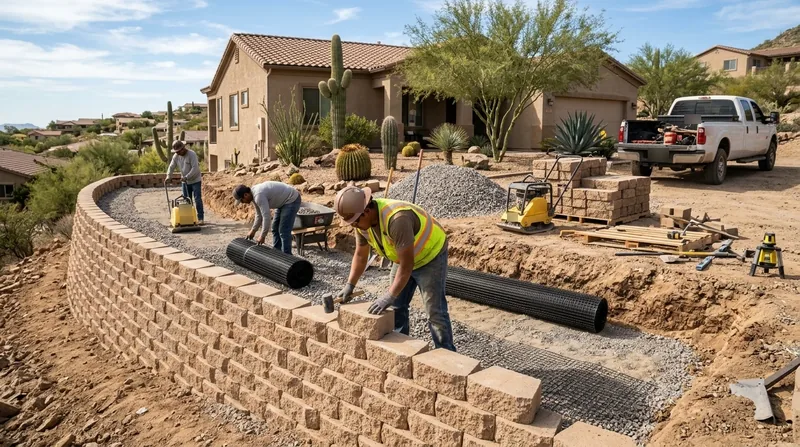




Tucson spreads across a broad desert basin that climbs hard into the Santa Catalina, Rincon and Tucson Mountain foothills, and almost every yard here sits on a grade that wants to move. From the adobe rowhouses of Barrio Viejo to the 1950s slump-block ranches of midtown and the stucco-and-tile hillside lots in the Catalina Foothills and Oro Valley, homeowners need walls that hold soil against caliche hardpan, expansive clay and July monsoon runoff. Block & Segmental Retaining Walls in Tucson are the workhorse answer: mortarless engineered block, geogrid reinforcement, and a face that looks right against desert landscaping. We install Allan Block, Versa-Lok and Keystone systems built for this ground, not for a wet-climate subdivision. If you are comparing wall types, start with our retaining wall installation service to see how we scope a project.
Why Segmental Block Walls Make Sense on Tucson Ground
Tucson soil does two things that wreck weak walls. Caliche hardpan stops water from draining down, so it pushes sideways, and pockets of expansive clay swell after a storm and shrink in the dry heat. Then the monsoon arrives and turns a dry arroyo into a torrent in twenty minutes. A segmental wall handles that because each block interlocks and the geogrid ties the wall back into the hillside, so the whole mass works together instead of one face taking the load.
- We set every wall on a compacted, excavated base course so it does not settle into decomposed granite.
- We install geogrid in lifts behind the block to resist overturning and sliding on sloped lots.
- We build drainage gravel and outlet pipes into the wall so monsoon water exits instead of stacking up.
- We cap the top course and cut block on curves to fit xeriscape beds and desert terraces.
That combination is why a properly built segmental wall outlasts the timber and railroad tie beds still holding up half the older yards in Sam Hughes and Armory Park.
Key info: In the Catalina Foothills and Starr Pass, cut-and-fill lots often need a tiered segmental wall with geogrid rather than one tall face. Tiers break up the load and keep each wall under the height where engineered drawings and a city permit come into play.
Height thresholds, setback rules and engineering requirements vary by jurisdiction, so confirm the current requirements with the local building department before you build. The City of Tucson's permit information is a good starting point: City of Tucson.
How We Build a Segmental Wall in Tucson, Step by Step
Every wall starts with the ground, not the block. We walk the site, check the slope above and below, look for caliche and clay layers, and figure out where water will go during a monsoon. Then we lay out the wall line, confirm setbacks from the property line, and set the base. The block only goes down after the base is dead level and compacted.
- We excavate and compact a base trench to the depth the wall height and soil require.
- We set and level the first course, which controls the line and grade of the entire wall.
- We stack block in running bond, cutting units for curves, corners and steps.
- We place geogrid layers and compact the backfill in lifts as the wall rises.
- We install drainage gravel, filter fabric and outlet pipes behind the wall.
- We cap the wall, clean the site and walk you through what was built.
On a recent job in Casas Adobes, we replaced a leaning timber bed with a curved Allan Block wall tied into geogrid on a slope that drained straight toward the patio. The wall now carries the grade and sends storm water around the house instead of under it.
Key info: If your wall sits near a wash or arroyo, drainage design matters as much as the block. See how we handle retaining wall drainage so monsoon flow does not undermine the base.
Segmental Wall Approaches We Use
Not every wall needs the same system. A garden terrace in Vail and a tall hillside wall in Oro Valley are different engineering problems, and we match the block, the reinforcement and the drainage to the site. Here is how the main approaches compare.
| Approach | Description | Best for |
|---|---|---|
| Allan Block | Pin-connected block with geogrid, easy to curve and cap | Garden terraces, curved beds, mid-height walls |
| Versa-Lok | Solid, heavy block with a tight fit and clean vertical face | Taller walls and straight runs where strength matters |
| Keystone | Fiberglass pin system with geogrid for reinforced soil | Sloped lots and walls carrying a surcharge |
| Tiered segmental wall | Two or more stepped walls with planting between | Hillside lots in the foothills and Starr Pass |
| Segmental wall with drainage system | Gravel, fabric and outlets built into the wall | Wash-adjacent yards and clay-heavy ground |
Block & Segmental Retaining Walls Cost in Tucson: What to Expect
Most segmental walls here start around From $25/sq ft, and that figure moves with the site. Wall height is the biggest driver, because taller walls need more geogrid, more base depth and sometimes engineered drawings. Access is next: a wall in a tight Catalina Foothills lot where a machine cannot reach costs more in hand labor than an open lot in Marana. Soil conditions, curve work, cap style and drainage all shift the number too.
That is why we price after a site visit, not over the phone. Two or three estimates on the same scope is the smart move, and you should expect each one to explain the base, the reinforcement and the drainage, not just the block. Our pricing overview breaks down what drives the range. Never choose a wall bid on the lowest number alone if it skips the drainage layer.
What to Look For When Hiring a Retaining Wall Contractor Near Tucson
Hiring near Tucson means hiring someone who knows desert soil. Ask for a current license and insurance certificate, and confirm the policy covers retaining wall work. Get at least two or three written estimates that spell out base prep, geogrid and drainage. Ask for local references, ideally a wall on ground like yours, and check that the contractor will pull permits where the building department requires them.
Also ask how they handle HOA rules if you live in a planned community, and whether they will coordinate with the city on setbacks near a property line. A contractor who hesitates on those questions is a risk. You can contact us for a free estimate and we will walk the site with you.
Block & Segmental Retaining Walls Near Me: What Tucson Homeowners Should Know
If you are searching for segmental wall work near you, the main thing to know is that most failures in this city trace back to water and base prep, not the block itself. Walls that lean or bulge after a monsoon usually had no drainage gravel, no geogrid, or a base set on loose decomposed granite. Fixing those walls early is cheaper than replacing them.
We build and repair segmental walls across the basin, from Green Valley to the foothills, and we can tell you on site whether your wall needs a rebuild or a targeted fix. Call (520) 467-5911 and we will set up a time to look at it.
Block & Segmental Retaining Walls in Tucson: Pricing Guide
| Service | Price | Details |
|---|---|---|
| Garden terrace wall (up to 3 ft) | Starting at $25/sq ft | Includes base prep, block, cap and drainage gravel for low walls in open yards. |
| Hillside or tiered wall | Starting at $35/sq ft | Adds geogrid, deeper base and machine access planning for sloped foothill lots. |
| Wall with full drainage system | Starting at $30/sq ft | Includes gravel, filter fabric and outlet pipes for wash-adjacent or clay-heavy ground. |
| Complex or large-scale job | On estimate | Tall walls, engineered drawings and tight access need an on-site look before pricing. |
| Travel | Included | In Tucson and surrounding areas, no separate call-out or mileage fee. |
| Estimate | Free | Response within 24h at (520) 467-5911, no obligation to book. |
Indicative pricing, the exact cost depends on square footage, finish, and site access. Free personalized estimate within 24h at (520) 467-5911.


