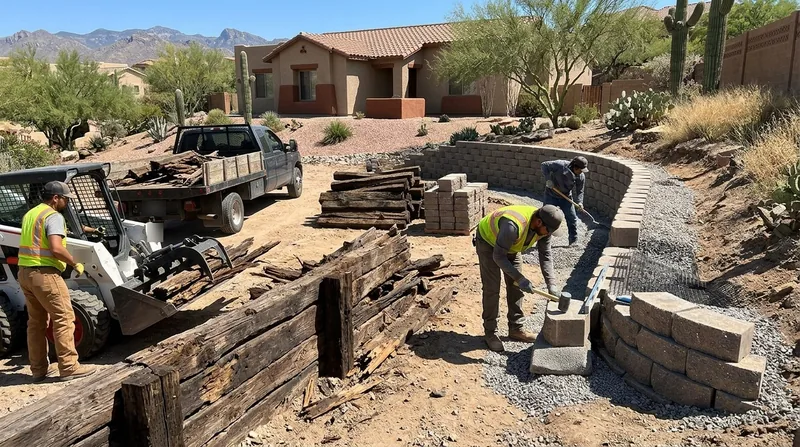




Railroad Tie Wall Replacement in Tucson
If your yard still has a railroad tie wall from the 1970s or 1980s, you are looking at a structure that has outlived its useful life. Railroad Tie Wall Replacement in Tucson means pulling out creosote-soaked ties that are rotting, bowing, and leaching, then rebuilding the wall with segmental block, stuccoed CMU, or natural stone that matches the desert. Tucson spreads from the basin floor up into the Santa Catalina, Rincon, and Tucson Mountain foothills, and those old tie walls sit on slopes in Catalina Foothills, Tanque Verde, and Oro Valley where monsoon runoff and caliche hardpan do the most damage. We handle demolition, haul-away, drainage, and the full rebuild. If your wall is leaning or has already started to collapse, start with leaning and collapsed wall repair before the situation gets worse.
Why Old Railroad Tie Walls Fail in the Tucson Desert
Creosote-treated ties were never meant to last fifty years in this climate. The hard white sun bakes the timber, the creosote dries and cracks, and the first heavy monsoon rain soaks into the exposed end grain. Once water gets behind the ties and hits the caliche layer, it has nowhere to go, so it pushes. Ties rot from the back face out, and by the time you see the bow, the wall is already structural trouble.
- Caliche hardpan traps water behind the wall and rots the ties from the inside out.
- Expansive clay pockets swell after monsoon storms and shove the wall face forward.
- Decomposed granite washes out of the backfill and leaves voids behind the ties.
- Creosote leaching kills adjacent plantings and stains patios and driveways.
- Termites and dry rot hollow out the lower courses where ties meet soil.
Any one of these is enough to justify replacement, and most Tucson tie walls have three or four working at once. The sooner you pull the old wall, the less likely you are to be dealing with a collapsed slope and a much bigger bill.
Key info: A tie wall on a Catalina Foothills cut-and-fill lot above a driveway is a surcharge wall. Once the ties rot, the driveway and the slope above it are both at risk, so we treat those as priority replacements. Walls above roughly 4 feet, or walls holding up a surcharge, usually need a permit through the local building department, and thresholds vary by jurisdiction.
For official permit requirements, check the City of Tucson building department before any wall work begins.
How We Replace a Railroad Tie Wall in Tucson, Step by Step
We do not just pull the ties and drop new block in the same hole. The old wall failed for a reason, usually drainage, and if we do not fix the water path the new wall will fail the same way. Every replacement starts with a site read: slope grade, soil type, where the monsoon runoff actually goes, and what the wall is holding up. Then we build it back correctly.
- We walk the site and mark the wall line, utilities, and any plantings worth saving.
- We demolish the ties, cut them to manageable lengths, and haul them off site.
- We excavate to the new footing depth and expose the slope face behind the old wall.
- We install gravel backfill, filter fabric, and a perforated drain pipe that daylights at the low end.
- We set the new wall in segmental block, stuccoed CMU, or natural stone, matching the house.
- We compact the backfill in lifts and cap the wall with the finish you choose.
Each step gets checked before we move to the next, so the drainage is working before the wall face goes up. If the slope above the wall needs work too, we bring in slope stabilization and erosion control rather than rebuild on a failing grade.
Key info: On a recent job off Tanque Verde Road, the old ties were holding back a decomposed granite slope above a pool deck. We pulled 34 feet of tie, rebuilt the drainage, and replaced it with a segmental block wall tied into the pool coping. The homeowner got the deck back and stopped the washout that was undercutting the patio.
Replacement Options for Tucson Tie Walls
Once the ties are out, you have real choices about what goes back in. The right pick depends on wall height, what the wall holds up, and how the finish needs to look against the house. We build all four options below and will tell you straight which one fits your site.
| Approach | Description | Best for |
|---|---|---|
| Segmental block | Engineered interlocking units with gravel backfill and drain pipe. | Most residential tie replacements, 3 to 6 feet. |
| Stuccoed CMU | Grouted block wall finished to match the house stucco. | Visible walls against adobe and stucco homes. |
| Natural stone or boulder | Mortared or dry-stacked granite and river rock. | Hillside lots and landscape walls in the foothills. |
| Tiered rebuild with drainage | Two shorter walls with a drainage bench between them. | Tall walls where a single face would need engineering. |
Each option gets the same drainage detail behind it, because that is what keeps the new wall standing. If you want to compare block against poured concrete, the block and segmental retaining walls page covers the trade-offs.
Railroad Tie Wall Replacement Cost in Tucson: What to Expect
Most tie wall replacements in Tucson start around From $35 per square foot of wall face, and that figure includes demolition, haul-away, drainage, and the new wall. The real number depends on what the wall is holding up, how tight the access is, and how much site work the slope needs before the new wall goes in.
Four things move the price most:
- Wall height and surcharge. A wall holding a driveway or structure needs engineering and a heavier footing.
- Access. Backyard walls in Sam Hughes with no alley access cost more to demo and rebuild than a front wall on a wide lot.
- Soil and drainage. Caliche and expansive clay mean more excavation and more gravel backfill.
- Finish material. Stuccoed CMU and natural stone run higher than standard segmental block.
Get two or three written estimates and compare what is actually included, especially drainage. A cheap bid that skips the drain pipe is not a cheaper wall, it is a wall you will replace again. Our full pricing overview breaks down how we build estimates.
Hiring a Retaining Wall Contractor Near Me in Tucson: What to Check
Replacing a tie wall is structural work, so hire someone who can show you the paperwork and the references. Arizona requires contractors to be licensed, and any wall contractor working on your property should carry both liability insurance and workers compensation.
- Confirm the license is active and the insurance certificate is current before work starts.
- Get two or three written estimates that itemize demolition, drainage, and the new wall.
- Ask for references from walls of similar height and soil conditions, not just any job.
- Find out who pulls the permit if your wall is over the height threshold or holds a surcharge.
- Check HOA rules on wall height, material, and color before you order block.
A contractor who hesitates on any of these is not the one to trust with a wall holding up your slope. Reach out through our contact page and we will walk your site and give you a straight answer.
Railroad Tie Wall Replacement in Tucson: Pricing Guide
| Service | Price | Details |
|---|---|---|
| Standard tie wall replacement | Starting at $35/sq ft | Includes demolition, haul-away, gravel backfill, drain pipe, and new segmental block wall face. |
| Stuccoed CMU replacement | Starting at $48/sq ft | Grouted block wall finished to match house stucco, with full drainage behind the wall. |
| Natural stone or boulder replacement | Starting at $55/sq ft | Mortared or dry-stacked stone with gravel backfill, priced by stone type and wall height. |
| Complex or large-scale job | On estimate | Tall walls, surcharge walls, tight access, and engineered designs need an on-site look first. |
| Travel | Included | In Tucson and surrounding areas, no separate call-out or mileage fee. |
| Estimate | Free | Response within 24h at (520) 467-5911, no obligation to book. |
Indicative pricing, the exact cost depends on square footage, finish, and site access. Free personalized estimate within 24h at (520) 467-5911.


